







Hassan Hemti1, Alireza Nouri2,
1-Chairman of the Board of Directors of Jahan Orum Oyaz Company
2-Managing Director of Jahan Orum Oyaz Company
Abstract
Iran’s textile and clothing industry, taking advantage of its long history, large investment volume, high value-added rate, upstream and downstream linkages with other industries, and effective role in the national economy, as well as the employment of abundant human resources, has a potential capacity for progress and quantitative and qualitative improvement of itself and the national economy. The textile industry is the third strategic industry in Iran, and this indicates its importance in the policies and macro-planning of the country of Iran. Based on the Visionary Document of 1404, Iran’s textile industry should reach the third rank in the region (Middle East) and the fiftieth rank in the world. Statistics show that Iran’s foreign exchange earnings from total textile and clothing exports this year exceeded $312 million, while according to data from the Turkish Exporters’ Council, the country earned $19.5 billion from clothing exports between January and November 2022. In the present study, which was conducted through a review and documentary study, the role and importance of the textile industry in the growth of the national economy and the development of non-oil exports have been examined. The results of this study show that commodity smuggling, high prices of raw materials, and the lack of continuous and effective communication between scientific communities and industry are among the main obstacles to the growth and development of the textile industry. In addition, these results show that if the aforementioned obstacles are removed or modified, the textile industry has a greater chance of developing and succeeding in the global arena and connecting to the global value chain compared to industries such as petrochemicals and automotive.
Keywords: Textile industry, national economy, textile exports, management, development, international trade .
Introduction
Iran’s textile and clothing industry, taking advantage of its long history, large investment volume, high value-added rate, forward and backward linkages with other industries and the national economy, and abundant human resources, has potential for progress and improvement in its quantity and quality and that of the national economy. However, unfortunately, over the years, the production of textiles has been accompanied by many challenges and problems (Shafi’i, 2010). High cost of products compared to similar foreign goods, lack of advanced knowledge and weak technology, provision of liquidity and working capital, industrialists’ debt to banks, high interest rates, worn-out machinery, backwardness in the field of clothing fashion, adoption of variable tariff policies for export and import of goods, weak production laws and regulations in the country, reduced productivity, domestic stagnation, and disorganized business environment are among the constraints that industrialists in the textile sector are struggling with today. Under the influence of these factors and the lack of competitiveness with foreign products, Iran’s textile industry has not been able to achieve a suitable position in the world trade of textiles and clothing (Azizi, 2001).
Considering the great progress of the textile industry in our country and the investments made in purchasing machinery, it is still not possible to offer diverse products and satisfy customers and reach foreign markets and even the domestic market. It seems that in this meantime, the pivotal role of management has been forgotten (Ebadi, 1400).
Iran’s foreign exchange earnings from total textile and clothing exports this year have exceeded $312 million, while according to data from the Turkish Exporters’ Council, the country earned more than $19.5 billion from clothing exports between January and November 2022. Based on the Visionary Document of 1404, Iran’s textile industry should reach the third rank in the region (Middle East) and the fiftieth rank in the world. Currently, it is not even among the top 50 textile countries in the world. Eleven industries have been selected as strategic industries in Iran. The textile industry is the third strategic industry in Iran, which is an indication of its importance in the country’s macro-policymaking and planning. However, the lack of attention paid to the textile and clothing industry in Iran has led to this industry not only not experiencing growth in recent years, but on the contrary, it has also faced significant stagnation
The level of foreign exchange investment to establish a business in the textile industry is very low compared to many other industries. Since this industry has the highest employment generation capacity compared to economic sectors at the national level and also among sub-sectors of the industry, about 18 percent of employment in the textile-dependent industry is related to it, and Iran’s textile industry is ranked after the oil industry in terms of employment generation, but it still faces many difficulties such as smuggling of goods, heavy tariffs, illegal imports, lack of liquidity, and the manner of implementing the Industrial Restructuring Law (Banoei, 2001).
Research Method
This research was conducted based on a review of the existing literature and documents in this field. In this study, a comprehensive search was conducted in the relevant databases based on the keywords “textile industry”, “national economy”, “textile exports”, “management”, “development”, “international trade”. The background of the studies found is described below.
Research Background
Shafii and colleagues conducted a study in 2010 with the aim of identifying and ranking the challenges of production development and policies and strategies to improve the situation in the textile industry. In this study, 11 policies and 33 strategies were identified from the literature on the subject and interviews with experts, and using the consensus ratio (CVR) index, steps were taken to select important policies and strategies to address the challenges. The results of this study showed that the high price of finished products compared to similar foreign goods, lack of advanced knowledge and weak technology, lack of liquidity and capital in circulation, industrialists’ indebtedness to banks, high interest rates, worn-out machinery, backwardness in the field of garment manufacturing, adoption of variable tariff policies for exports and imports of goods, weak production laws and regulations in the country, reduced productivity, internal stagnation, and disorganized business environment, among others. There are challenges in the textile industry (Shafi’i, 2010).
In 2013, Kashi and colleagues conducted a study aimed at investigating the impact of textile smuggling on productivity in the Iranian textile and clothing industry from 1996 to 2007. In this study, after estimating the volume of textile and clothing smuggling, its effect on productivity growth was analyzed in the form of an auto-explanatory model with extended ARDL intervals, and the findings of this study indicated that commodity smuggling has a negative and significant effect on productivity growth in these industries (Kashi, 2013).
In 2011, a study was conducted by Roshan and Bakhtiari with the aim of examining the problems of the textile industry (weaving) in Iran and the measures taken by advanced countries in this industry. In this study, a proper analysis of the Iranian textile industry was presented. The main problems facing the Iranian textile industry that were identified in this study were:
- Smuggling of textiles into the country.
- Inability to provide raw materials of the desired quality and at a low price.
- Problems arising from the regulations of the Social Security Organization.
- Failure to pay export subsidies on time.
- Increase in the price of finished products.
- Depreciation of production machinery in a number of production units (Roshan, 2011).
In 2010, Bayati conducted a study on the statistics and production information of the member units of the Iranian Textile Industries Association and their problems. The results of this study showed that the reasons for the decrease in production of the studied units are, in order: lack of liquidity, lack of sufficient buyers and decrease in demand, high prices and shortages of raw materials, excessive imports of similar products, economic recession, increased labor costs and rising prices of finished goods, and insecurity of receipt of checks (Bayati, 2010).
In 2005, Kimiagri and colleagues conducted a study aimed at investigating the improvement of management productivity in the textile industry using the benchmarking method. The findings of this study showed that in order to preserve the textile industry, textile manufacturers must have the capabilities to operate in competitive textile production and to survive in competitive markets globally and domestically in terms of quality, price, and rapid production processes. These possibilities include: producing or providing the necessary facilities for the textile industry to obtain the desired raw materials, replacing the value-added tax law and quickly eliminating all existing obstacles to the textile industry, reducing inflation and lowering bank interest rates for industries similar to those in other countries of the world, ensuring investment security and creating a suitable environment for investors and shareholders of textile units, seriously and comprehensively preventing the entry of smuggled goods into the country, and finally, implementing the right to reform. Manpower structure and replacement of 10 percent of workers in textile production units throughout the year in return for payment of all workers’ legal claims. In addition to the aforementioned solutions, this study discussed human resources and, in particular, management productivity (Kimiyaghri, 2005).
Findings
Obstacles to the development of the textile industry in Iran based on studies and research conducted:
- Smuggling of textiles into the country
- Uncontrolled imports of similar products
- Inability to provide raw materials of the desired quality and cheap price
- Failure to pay export subsidies on time
- High price of finished products compared to similar foreign goods
- Depreciation of production machinery in a number of production units
- Adoption of variable tariff policies for exports and imports of goods
- Weak production laws and regulations in the country
- Internal stagnation and disorganization of the business environment
- Lack of advanced knowledge and weak technology
- Low level of available human resources in terms of skills and required specializations, mainly in the management, technical, design, spinning, finishing and sales sectors (Dezfouli, 2008)
- Traditional nature of textile activities, low efficiency of machinery and their mechanization coefficient (Ardakan, 2012)
- Weakness of hardware and software infrastructure (transportation, storage, packaging, marketing, etc.) 14. Lagging behind in the field of clothing manufacturing
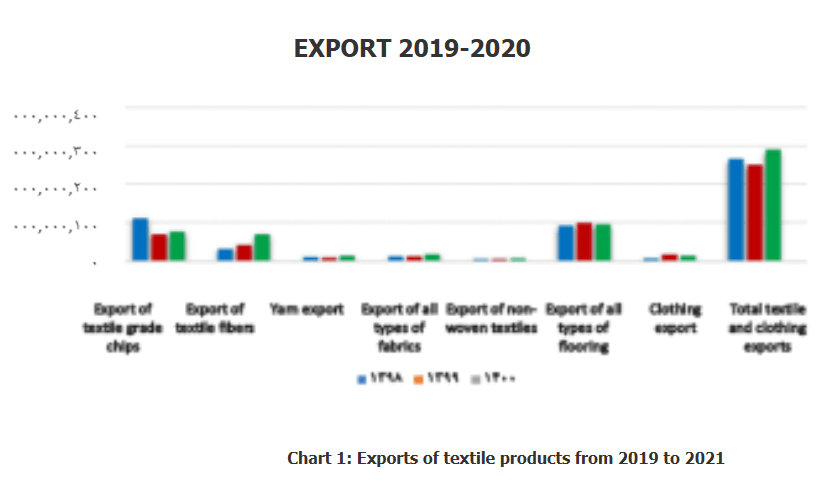
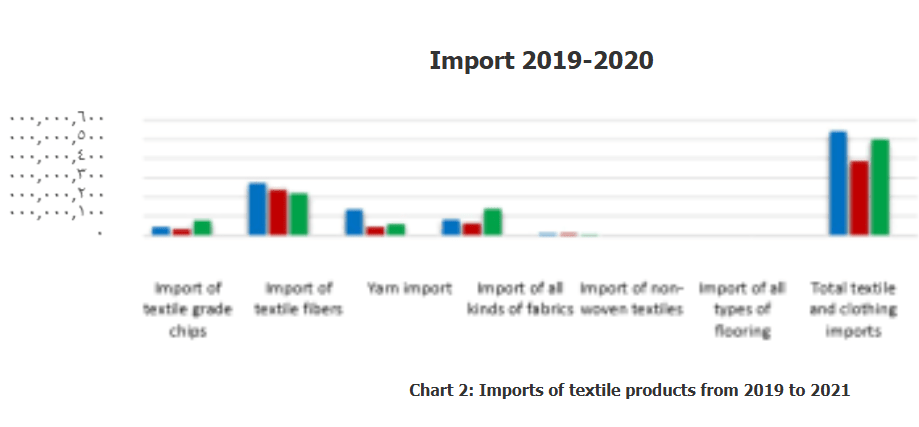
In order to draw a reality-based model of the development process of the textile industry, the Statistical and Strategic Studies Office of the Textile Industry, Iranian Textile Industries Association, has examined the import and export statistics of the textile and clothing sector for the period 1398 to 1400 (Iranian Textile Industries Association, 1401). Figure 5-1 shows exports and Figure 5-2 shows imports of this sector. Last year, despite a 22 percent increase in imports in this sector, exports grew by only 13 percent. This factor is one of the main obstacles to the growth and development of the textile industry.
Discussion and Conclusion
As shown in Figure 1, most of our exports Discussion and Conclusion in order are related to floor coverings, grid chips, and fibers, and most of our imports in order are related to textile fibers, fabrics, and yarn, respectively (Figure 2). Therefore, more investment should be made in the field of flooring, grade chips, and fibers to generate more foreign exchange for the country, and efforts should be made to increase the production of quality fibers and fabrics within the country to prevent Foreign exchange outflow from the country. Statistics for 2019-2020 show that in the textile fiber sector, our exports have increased and our imports have decreased. The textile industry, due to its user-friendliness and complexity, can attract and activate the country’s inactive population more easily than other industries. This is while this industry has a greater chance of developing and succeeding on the global stage and connecting to the global value chain compared to industries such as petrochemicals and automotive. The widespread smuggling of clothing and fabrics from countries such as China, Turkey, the Emirates, Thailand, and others has put the country’s textile industry in crisis. Estimates show that the volume of smuggling of fabrics and clothing exceeds the export volume in these industries. According to information from the Ministry for Combating Smuggling of Goods and Currency, textile and clothing products occupy the second position in terms of smuggling statistics (Kashani, 2013). According to statistics, Turkey’s textile exports in 2021 were $16.16 billion. This figure was 23 times the exports of Iran’s textile industry in 1400. According to statistics, Turkey’s textile exports in 2021 were $16.16 billion. This figure was 23 times the exports of Iran’s textile industry in 1400. Among the challenges and management obstacles to the development of the textile industry in Iran are the high cost and shortage of raw materials, excessive imports of similar products, economic recession, increasing labor costs and rising prices of finished products (Bayati 2010), weak ties between universities and educational centers and the industry, and the shortage of skilled human resources, the elimination of which requires serious determination from policymakers, industrialists, and academics.
References
[1]Shafii, Shokofeh and Abbasi, Reza and Habibi Rad, Amin, 2010, Identification and ranking of challenges in production development, policies and strategies for improving the situation in the textile industry (case study: production of black veil fabric), https://civilica.com/doc/1214217
[2] Firuzeh Azizi, Fatima Pasban, 2001, Study of the Production and Added Value of the Textile Industry in Iran and the Impact of the Government’s Fiscal and Monetary Policies on It during the Period 1979 to 1998, Economics Research Institute, Al-Zahra University [3] Seyyed Vahid Ebadi, Hanif Kazrooni, Dariush Semnani, Strategies for the Development of Iran’s Advanced Textile Industry, Strategic Management Studies, No. 45 – Spring 1400
[4] Ali Asghar Banovi, Mina Mahmoudi, Quantitative study of the position of the textile industry in the national economy and calculation of its potential employment generation capacity in the form of a quasi-matrix system of social accounting, 1380, Allameh Tabatabaei University [5] Khodadad Kashi, Farhad and Firuz Jang, Haniyeh, 1392, Study of the impact of textile smuggling on productivity in the textile and clothing industry of Iran (1375-1386), https://civilica.com/doc/1410167
Chemistry Gray, Dr. Ali Mohammad and Shams, Dr. Nasser and Soleimanzadeh, Engineer Masoud, 2005, Improving Management Productivity in the Textile Industry by Benchmarking Method, Third International Management Conference, Tehran, https://civilica.com/doc/66025
[7] Shokohi, Mehdi and Maroti, Ali, 2014, Iran’s Textile Industry from Past to Present; Challenges and Strategies, Second National Conference on Management Dynamics, Economic Development and Financial Management, Shiraz, https://civilica.com/doc/316813 [8] Roshen, Seyed Aliqli, Bakhtiari, Kulthum (2011). A Study of the Problems of the Textile Industry (Weaving) in Iran and the Measures Taken by the Leading Countries in This Industry. Business Studies Publication, 48, 28-40.
[9] Bayati, Leila (2010). Statistics and Production Information of the Association’s Member Units and Their Problems, Office of Statistical and Strategic Studies of the Textile Industry, Iranian Textile Industries Association.
[10] Office of Statistical and Strategic Studies of the Textile Industry, Iranian Textile Industries Association.
[11] Ivy Ardakan, Mohammad, Motamedi, Mahdiyeh (2012). Investigating the factors that inhibit and promote the growth and development of industrial clusters (a case study of the textile cluster in Yazd province). Management Improvement Journal, 17, 226-203.
[12] Hedayati Dezfouli, Ahmadreza (2008). Foreign Investment in the Textile Industry of Iran, Textile and Clothing Industry Journal 297, 44-40.